Recommended for you
The Ultimate Barcelona Travel Experience: My Personal Journey
Visiting Sagrada Familia: A Personal Journey Through Gaudí’s Dream
I still vividly remember the morning I decided that visiting Sagrada Familia would be the focal point of my entire trip to Spain. For years, I had seen the glossy magazine photographs, watched the travel documentaries, and heard the enthusiastic testimonials of friends. Yet, the idea of visiting Sagrada Familia had slowly grown into a deeply personal obsession. The prospect of finally standing before the monumental structure was both exhilarating and intimidating. So, when I finally found myself walking the lively, sun-drenched streets of Catalonia, visiting Sagrada Familia was no longer just a simple checkbox on a tourist itinerary; it was the realization of a lifelong dream.
The entire process of visiting Sagrada Familia begins long before you actually step foot onto the premises. It starts in your mind, as you try to comprehend the sheer scale and audacity of Antoni Gaudí’s vision. I remember waking up at dawn on the day I planned on visiting Sagrada Familia. The Mediterranean air was crisp, and the distant sounds of Barcelona waking up provided a soothing soundtrack to my anticipation. The excitement of visiting Sagrada Familia made it impossible to sleep any longer. I poured myself a strong, dark coffee, sat on the small balcony of my rented apartment, and mentally prepared myself for the profound experience of visiting Sagrada Familia.
As I navigated the geometric grid of the Eixample district, the anticipation of visiting Sagrada Familia grew with every block. I was intentionally keeping my head down, not wanting to catch a premature glimpse of the spires. The magic of visiting Sagrada Familia, I had been told by a local, lies in the sudden, overwhelming reveal. And they were absolutely right. When I finally looked up at the corner of Carrer de Mallorca, the sheer visual impact of visiting Sagrada Familia hit me like a physical force. The towers seemed to pierce the sky, organic and surreal, looking less like a building and more like a massive, petrified forest rising from the urban concrete.
The Awe of the Nativity Facade
My actual experience of visiting Sagrada Familia began at the Nativity Facade. This is the only part of the basilica that Gaudí saw largely completed before his tragic death, and spending time here is an essential aspect of visiting Sagrada Familia. The level of intricate detail is difficult to process. While visiting Sagrada Familia, I found myself staring for nearly an hour just at this single wall of stone. It is dripping with life—literally. Stone turtles support massive columns, carved foliage seems to grow organically from the arches, and biblical figures appear to be frozen in mid-conversation.
The joy of visiting Sagrada Familia is found in these microscopic details. I realized very quickly that visiting Sagrada Familia is not a passive activity; it demands your full attention. The facade acts as a visual Bible, but written in the language of nature. It felt chaotic at first, almost overwhelmingly busy, but as I continued visiting Sagrada Familia and allowed my eyes to adjust, the profound harmony of Gaudí’s design revealed itself. The sheer dedication required to carve such a masterpiece is humbling, and recognizing that human hands sculpted every leaf and feather is a crucial part of visiting Sagrada Familia.

Many travelers assume that visiting Sagrada Familia is mostly about admiring this famous exterior. I used to think the same. However, the true transformation that occurs when visiting Sagrada Familia happens the moment you cross the threshold and step inside. I had prepared myself for something grand, but nothing could have truly prepared me for the interior. The physical act of visiting Sagrada Familia and stepping through those heavy bronze doors, adorned with ivy and insects, felt like crossing into another dimension.
Stepping Into the Forest of Light
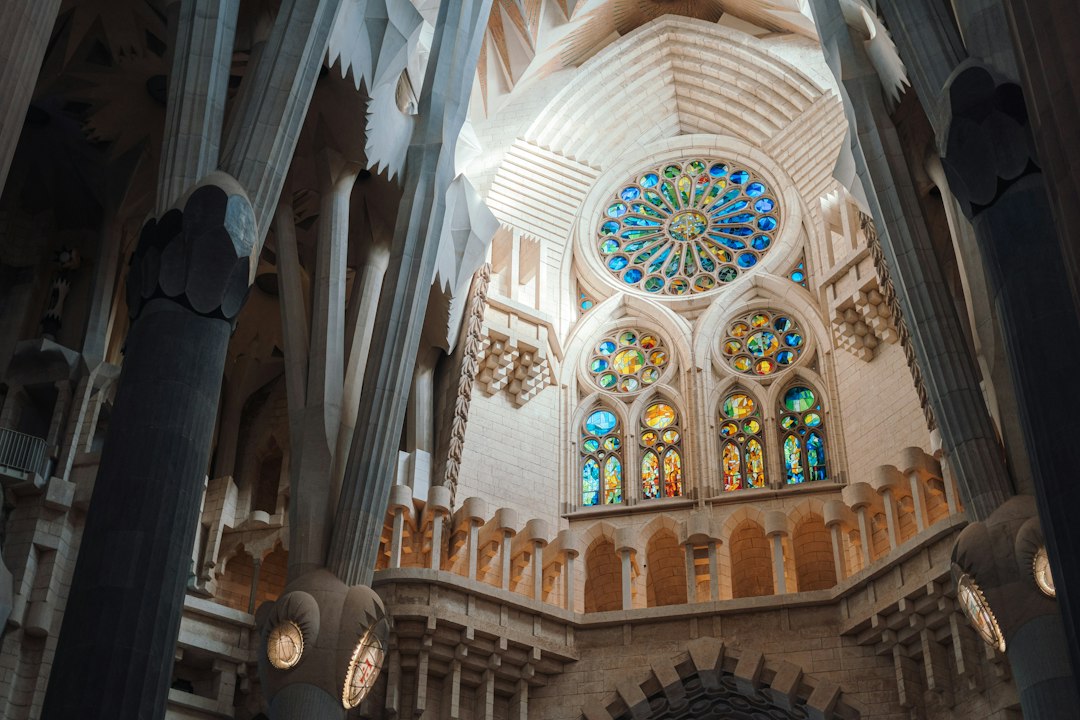
If you have ever considered visiting Sagrada Familia, you must prioritize seeing the interior during the daylight hours. The moment I walked in, I gasped audibly. I was not alone; looking around while visiting Sagrada Familia, you see a sea of people looking upward, jaws dropped, completely mesmerized. The genius of visiting Sagrada Familia lies in Gaudí’s intent: he did not design a traditional cathedral interior; he designed a spiritual forest. The towering columns branch out at the top, supporting a vaulted ceiling that looks incredibly like an intricate canopy of leaves.
The light is the true protagonist of visiting Sagrada Familia. On the eastern side, the cool morning light filters through stained glass windows bursting with oceanic blues and forest greens. As my morning of visiting Sagrada Familia progressed, I watched the light shift. By the time my visit extended into the afternoon, the western windows began to ignite. The experience of visiting Sagrada Familia became a baptism of warm, fiery light—vibrant reds, deep oranges, and golden yellows painting the stone floors and the tree-like columns.
I sat on one of the wooden pews, entirely overwhelmed. The emotional weight of visiting Sagrada Familia is something rarely captured in guidebooks. You don’t just look at the basilica; you bathe in it. Joan Vila-Grau’s stained glass work is modern, abstract, and entirely devoid of the traditional saints and historical figures found in standard Gothic cathedrals. Instead, the focus while visiting Sagrada Familia is on the pure, unfiltered emotion that color and light can evoke. I felt an incredible sense of peace, a rare commodity in such a heavily touristed space. The sheer magnitude of the interior space encountered while visiting Sagrada Familia makes you feel infinitesimally small, yet profoundly connected to the universe.
More Travel Memories
If my journey of visiting Sagrada Familia resonated with you, you might enjoy reading about the rest of my adventures in the Ultimate Barcelona Travel Experience: My Personal Journey.
The Stark Contrast of the Passion Facade
After hours of losing myself in the colorful interior, my journey of visiting Sagrada Familia continued outward to the Passion Facade. The contrast is violently beautiful. While the Nativity Facade is lush and overflowing with life, the Passion Facade is stripped bare, angular, and haunting. Designed by Josep Maria Subirachs long after Gaudí’s death, this side of the building is often a point of controversy for those visiting Sagrada Familia.
For me, the starkness was deeply moving. It reflects the pain and sacrifice of the crucifixion with brutal honesty. The sculptures are almost skeletal, their faces rigid with sorrow. A key aspect of visiting Sagrada Familia is embracing this dichotomy—the celebration of birth on one side, the agony of death on the other. It made visiting Sagrada Familia feel like a complete narrative experience, a journey through the entire spectrum of human and divine emotion.
I took my time tracing the narrative carved into the stone. Every detail, from the magic square that always adds up to thirty-three, to the faceless figure of the centurion, added layers to my understanding. The deeper you look while visiting Sagrada Familia, the more the building speaks to you. It is a masterpiece that demands interpretation and invites personal reflection. This is why visiting Sagrada Familia is never the same experience for two different people.
Ascending the Spires: A View from the Heavens
When planning my trip, I knew that fully visiting Sagrada Familia required purchasing a ticket to ascend the towers. I chose the towers on the Nativity side. The elevator ride up is swift, but the real adventure of visiting Sagrada Familia’s heights begins when you step out into the open air. The wind whipped through the stone bridges connecting the spires, and suddenly, I was standing hundreds of feet above the city.

The views are spectacular, but the true reward of this part of visiting Sagrada Familia is seeing Gaudí’s details up close. From the ground, the colorful pinnacles look like tiny drops of paint. Up close, I could see the intricate, shattered Venetian glass and colorful ceramics meticulously pieced together in the trencadís style. It struck me, while visiting Sagrada Familia from this vantage point, how Gaudí designed these exquisite details knowing full well that they would only be visible to the birds, the angels, and the workers. The dedication to beauty for beauty’s sake is a recurring theme when visiting Sagrada Familia.
The descent is an experience in itself. Walking down the incredibly narrow, snail-shell spiral staircase is a dizzying, thrilling part of visiting Sagrada Familia. There is no handrail on the inner edge, just a hypnotic drop down the center of the spire that looks like the inside of a colossal seashell. It is a brilliant reminder of Gaudí’s obsession with the perfect geometries found in nature. By the time my feet touched the solid ground of the nave again, I felt like I had returned from a different world.
The Museum: Uncovering the Process
No day spent visiting Sagrada Familia is complete without venturing into the museum located beneath the basilica. Here, I found the intellectual counterweight to the emotional high of the sanctuary. The museum provides the structural and historical context that makes visiting Sagrada Familia so fascinating. I spent a long time examining Gaudí’s inverted string models—complex webs of string and tiny weights that he used to calculate the perfect parabolic arches without the use of modern computers.
Seeing these models changed my perspective entirely. Before visiting Sagrada Familia, I thought Gaudí was merely a mad artist with a wild imagination. After visiting Sagrada Familia and studying his methods, I realized he was an unparalleled genius of engineering. He observed how trees supported their heavy branches and applied those exact principles to stone columns. The sheer brilliance of it makes the act of visiting Sagrada Familia an educational revelation.
I also saw the crypt where Antoni Gaudí is buried. Looking through the glass down into the dimly lit, active chapel, I felt a profound sense of gratitude. Gaudí gave the last forty years of his life exclusively to this project, sleeping in his workshop, dedicating every waking moment to the dream. Paying respects at his tomb is a quiet, powerful moment that grounds the monumental experience of visiting Sagrada Familia in the fragile reality of human mortality.
The Magic of an Unfinished Dream
As the sun began to set, my time visiting Sagrada Familia was drawing to a close, but I was not ready to leave. I walked across the street to the Plaça de Gaudí, a small park with a pond that perfectly reflects the basilica. Sitting on a wooden bench, watching the reflection of the massive structure ripple in the water, I reflected on my entire experience of visiting Sagrada Familia.
The fact that the basilica is still under construction is perhaps its most endearing quality. When you are visiting Sagrada Familia, you are not looking at a static piece of history preserved behind glass; you are witnessing a living, breathing project. You hear the sounds of drills and cranes mingling with the ringing of church bells. The cranes themselves look like temporary metal spires, adding to the chaotic beauty of the skyline. My memories of visiting Sagrada Familia are intertwined with the knowledge that I am part of a generation witnessing the final push toward completion.
Gaudí famously said, “My client is not in a hurry.” That philosophy permeates the very air around the site. The slow, methodical progress makes visiting Sagrada Familia a testament to patience and intergenerational cooperation. The architects and artisans working today are fulfilling the blueprints of a man who died nearly a century ago. Realizing this made visiting Sagrada Familia feel deeply unifying. It is a collective human achievement, an ongoing conversation across time between artists, architects, and the millions of travelers like me who come seeking inspiration.
I recommend visiting Sagrada Familia to anyone who will listen. Even if you are not religious, even if you do not typically enjoy architecture, visiting Sagrada Familia will affect you. It is a triumph of human imagination. It proves that we are still capable of building monuments that inspire unadulterated awe. My journey visiting Sagrada Familia was not just the highlight of my trip to Barcelona; it was one of the most remarkable experiences of my life.
When I finally stood up to leave the park, taking one last look at the illuminated facades against the darkening Catalan sky, I knew that my relationship with this building was not over. The memories of visiting Sagrada Familia will stay with me forever, a constant reminder of what is possible when human creativity is pushed to its absolute limits. I walked back toward the metro, exhausted but spiritually recharged, knowing that visiting Sagrada Familia had profoundly changed the way I see the world.