Recommended for you
The Ultimate Barcelona Travel Experience: My Personal Journey
My Great Wall of China Trek: A Personal Travel Story
Ever since I was a child flipping through the pages of old, faded encyclopedias in my school library, visiting the Great Wall of China has been an absolute obsession of mine. I remember running my fingers over the glossy photographs of the winding stone paths, imagining what it would feel like to stand on a structure so massive it seemed to defy human capability. Fast forward a couple of decades, and there I was, sitting in a cramped window seat on a fourteen-hour flight to Beijing, my heart pounding with a mixture of sheer exhaustion and unbridled anticipation. I was finally going to see the Great Wall of China in person. This wasn’t just another vacation for me; it was the realization of a lifelong dream, a pilgrimage to one of the most iconic testaments to human endurance and ingenuity. Today, I want to take you along on my deeply personal journey of exploring the Great Wall of China, sharing the sweat, the awe, and the profound historical echoes that made this trip the most unforgettable experience of my life.
Before you can even comprehend the magnitude of the Great Wall of China, you have to survive the beautiful, chaotic prelude that is Beijing. Arriving in the capital city was an absolute sensory overload. The moment I stepped out of the airport, the thick, humid air wrapped around me, carrying the faint scents of street food, exhaust fumes, and damp earth. I spent my first two days in the city adjusting to the brutal jet lag, wandering aimlessly through ancient hutongs, and trying my best to order steaming bowls of noodles using a translation app and frantic hand gestures. But no matter what I was doing—whether I was marveling at the sheer scale of the Forbidden City or biting into crispy Peking duck at a bustling local restaurant—my mind kept drifting toward the mountains to the north. The Great Wall of China was out there, waiting for me. I spent my evenings in my small hotel room obsessively checking the weather forecast and rereading articles about the different sections of the Great Wall of China. Should I go to the heavily restored and tourist-friendly Badaling? Should I risk life and limb climbing the wild, crumbling, and unrestricted ruins of Jiankou? Ultimately, after talking to a few seasoned backpackers in the hotel lobby, I decided that the Mutianyu section of the Great Wall of China would be the perfect middle ground: less crowded than Badaling, stunningly beautiful, and authentically rugged enough to give me the adventure I was craving.
Setting Out for the Great Wall of China
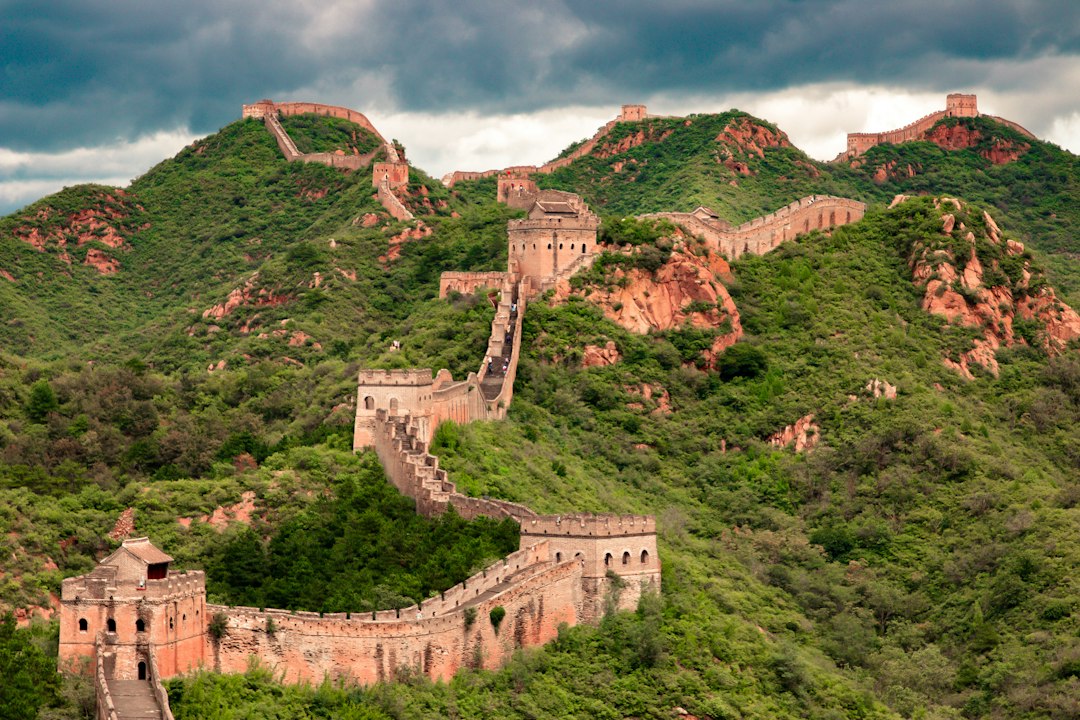
The morning of my trek to the Great Wall of China began long before the sun even considered rising. My alarm violently jolted me awake at 4:30 AM. Outside my window, the sprawling metropolis of Beijing was eerily quiet, draped in a thick blanket of pre-dawn fog. I quickly threw on my carefully laid out hiking gear, grabbed my backpack stuffed with excessive amounts of bottled water and granola bars, and headed down to meet my driver, a friendly local named Mr. Wei. The drive to the Great Wall of China took about two hours, transitioning from the concrete jungle of the city center into the lush, rolling countryside of Huairou District. As we navigated the winding mountain roads, the fog began to lift, revealing towering green peaks that looked like they had been painted by a Song dynasty master. I pressed my face against the cold glass of the car window, straining my eyes for a glimpse of stone. And then, suddenly, there it was. A thin, pale ribbon snaking along the highest ridges of the mountains. My breath hitched in my throat. Seeing the Great Wall of China from a distance for the first time is a deeply humbling experience; it doesn’t look like a building, but rather like a permanent geological feature, a spine of stone grown directly out of the earth’s crust.
When we finally arrived at the base camp for the Mutianyu section of the Great Wall of China, the air was crisp, and the morning sun was just beginning to cast long, golden shadows across the valley. There were a few different ways to ascend to the wall itself, including a grueling thousands-step climb or a rather terrifying open-air chairlift. Wanting to save my energy for the actual trek along the Great Wall of China, I opted for the chairlift. Dangling above the dense canopy of chestnut and pine trees, the silence of the valley was absolute. The only sound was the mechanical hum of the cable and the gentle rustling of leaves below. As the chairlift carried me higher and higher, the ancient fortifications of the Great Wall of China loomed larger, the weathered grey bricks coming into sharp focus. I felt a profound sense of reverence washing over me. This was it. I was about to walk on the same stones where Ming dynasty guards once stood watch over the northern frontier.

Stepping off the platform and planting my boots firmly on the pavement of the Great Wall of China was a surreal, out-of-body experience. The first thing that struck me was the sheer, unapologetic steepness of the terrain. The Great Wall of China does not respect human comfort; it was built to follow the most unforgiving, strategic contours of the mountains, which means its stairs are terrifyingly steep, uneven, and relentless. I took a deep breath, adjusted my backpack, and began my hike. Walking along the Great Wall of China is a fundamentally physical experience. Within the first twenty minutes, my calves were burning, and a layer of sweat had formed on my forehead despite the cool mountain breeze. Each step required focus, as the ancient bricks of the Great Wall of China were worn smooth by centuries of harsh weather and the millions of footsteps that had come before mine. But every time my lungs burned and I felt the urge to stop, I simply looked up. The panoramic views from the Great Wall of China are nothing short of majestic. To the north, the rugged, untamed wilderness of Mongolia stretched out like a vast green ocean; to the south, the fertile valleys of the Chinese heartland. I found myself repeatedly pausing, leaning against the cold stone battlements, and just trying to process the visual magnitude of my surroundings.
The Physical and Emotional Challenge of the Great Wall of China
As I pushed further along the Mutianyu stretch, the crowds of tourists near the cable car station began to thin out, leaving me largely alone with the ancient structure. This isolation allowed me to truly connect with the history of the Great Wall of China. I approached one of the many watchtowers that dot the wall at regular intervals. These towers, which once housed garrisons of soldiers, are incredibly atmospheric. I walked into the dark, stone-vaulted interior of a watchtower, running my hands along the rough brickwork. I thought about the men who built the Great Wall of China. It is estimated that millions of laborers, soldiers, and peasants worked on various sections of the Great Wall of China over centuries, and countless numbers of them died during its construction, their bodies supposedly buried within the foundations. Standing alone in the cool, silent shadow of that watchtower on the Great Wall of China, history felt less like a collection of dates in a textbook and more like a heavy, palpable presence. I closed my eyes and tried to imagine the terrifying roar of a northern invasion, the smoke signals rising from the adjacent peaks, the sheer isolation those ancient guards must have felt staring out into the vast unknown. Exploring the Great Wall of China forces you to confront the immense scale of human ambition and the incredible sacrifices made in the name of empire.
Continuing my trek, the path along the Great Wall of China became increasingly rugged. Some sections were beautifully restored, with smooth pavement and sturdy handrails, while others were left in a state of beautiful decay, nature slowly reclaiming the stones with wild grasses and creeping vines. This duality is what makes visiting the Great Wall of China so fascinating. It is both a meticulously preserved monument and an organic, crumbling ruin. I met a few other hikers along the way, exchanging breathless smiles and nods of encouragement as we tackled the grueling vertical climbs. There is a strange, silent camaraderie among those who choose to hike the steeper sections of the Great Wall of China; we were all enduring the same physical punishment for the sake of the same beautiful reward. At one point, I reached a section colloquially known as the ‘Stairway to Heaven,’ a near-vertical climb of several hundred terrifyingly narrow steps. My legs were shaking as I hauled myself up, practically crawling on my hands and knees near the top. But when I finally breached the crest and stood on the highest point of that section of the Great Wall of China, the view was worth every ounce of pain. The wall stretched out in both directions as far as the eye could see, a pale dragon riding the spine of the earth. I sat down on a weathered stone block, drank the last of my lukewarm water, and let the profound silence of the Great Wall of China wash over me. I had made it.
After several hours of intense hiking, exploring, and quiet reflection, it was time to begin my descent. But the Mutianyu section of the Great Wall of China holds one final, incredibly fun surprise for its visitors. Instead of taking the chairlift or walking back down the mountain, you have the option to ride a metal toboggan down a winding, luge-style track built right into the side of the valley. After the heavy, somber historical reflections of the morning, zooming down the mountain on a tiny wheeled cart felt absurdly joyful. The wind whipped through my hair as I navigated the sharp curves, laughing out loud as the ancient fortifications of the Great Wall of China blurred past me. It was a surreal juxtaposition—the solemn, bloody history of the Great Wall of China contrasting with the pure, childlike thrill of a mountain coaster. But perhaps that is the modern reality of the Great Wall of China. It is no longer a barrier of war; it is a bridge that brings people from all over the world together, allowing them to experience history, challenge themselves physically, and even have a little fun along the way.

Reflecting on My Journey to the Great Wall of China
When I finally reached the bottom, my legs felt like lead, my clothes were soaked with sweat, and I was covered in a fine layer of pale dust. Mr. Wei was waiting for me with a huge smile and an ice-cold bottle of water, which I drank in about three seconds flat. On the drive back to Beijing, I slumped against the car window, completely physically exhausted but mentally buzzing. The Great Wall of China had exceeded every single one of my impossibly high expectations. It wasn’t just big; it was emotionally overwhelming. The Great Wall of China demands respect. It demands physical effort, mental fortitude, and a willingness to confront the vast, complicated tapestry of human history. As I watched the rural landscape transition back into the dense urban sprawl of Beijing, I realized that my trip to the Great Wall of China had fundamentally changed me as a traveler. I no longer just wanted to see famous landmarks; I wanted to feel them, to sweat on them, to understand the blood and bone that went into their creation.
If you are reading this and wondering whether the Great Wall of China belongs on your own bucket list, my answer is an unequivocal, resounding yes. But please, when you go to the Great Wall of China, do not just treat it as a quick photo opportunity. Take the time to hike the steep sections. Walk away from the cable car crowds and find a quiet watchtower where you can sit in silence. Run your hands over the bricks of the Great Wall of China and think about the centuries of history contained within them. Travel responsibly, carry out your trash, and treat this ancient wonder with the reverence it deserves. Exploring the Great Wall of China is a privilege, a chance to step outside of our modern lives and walk in the footsteps of empires. I will carry the memories of my trek on the Great Wall of China with me for the rest of my life. The burning muscles, the breathtaking vistas, the haunting silence of the ancient stones—it was the journey of a lifetime. The Great Wall of China is not just a destination; it is a deeply personal experience that challenges you, humbles you, and ultimately leaves you in a state of absolute, unadulterated awe. I can only hope that one day, I will have the chance to return and walk another mile of that magnificent stone dragon.


