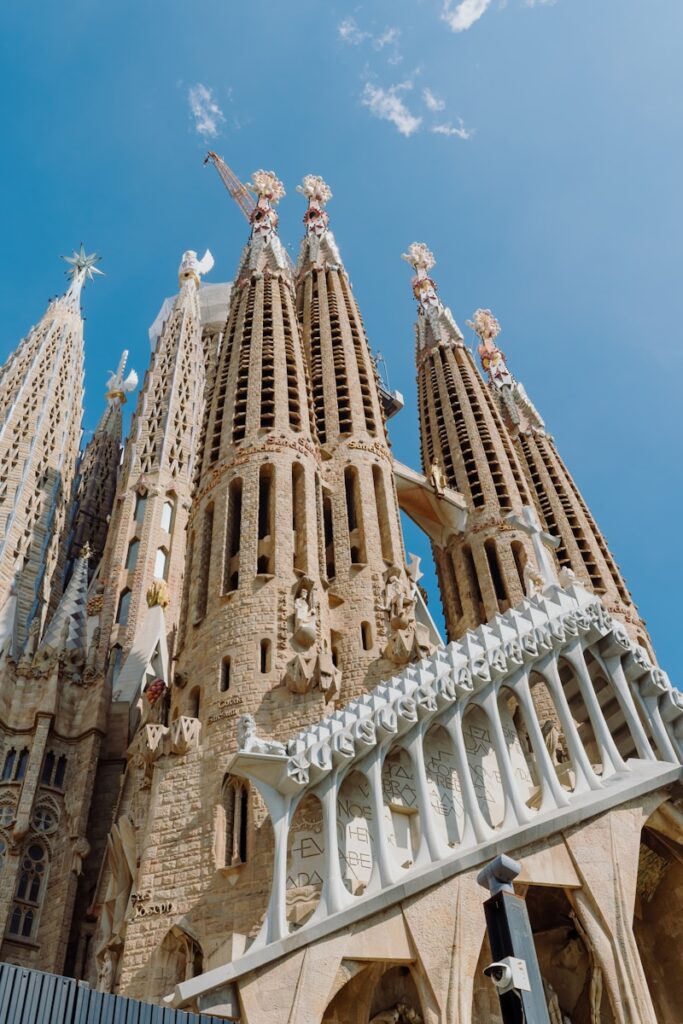
Rising like a colossal stone forest amidst the grid-like streets of Barcelona’s Eixample district, the Basílica i Temple Expiatori de la Sagrada Família stands as a testament to the limitlessness of human imagination and the depth of spiritual devotion. For over 140 years, this architectural marvel has been a work in progress, evolving from the visionary sketches of Antoni Gaudí into an international icon that defies traditional categorization. To visit the Sagrada Família is not merely to see a building; it is to witness a living organism of stone and light that continues to grow, breathe, and inspire wonder in every soul that passes through its towering portals.
The Visionary Behind the Stone
The story of the Sagrada Família is inseparable from the life of Antoni Gaudí, the father of Catalan Modernism. While the project began in 1882 under the architect Francisco de Paula del Villar, it was Gaudí who took the reins a year later and completely transformed the design. Gaudí saw himself as God’s architect, believing that nature was the ultimate expression of the divine. He moved away from the rigid lines of traditional Gothic architecture, opting instead for organic shapes, hyperboloids, and parabolic arches that mimicked the growth of trees and the curves of the human body. He spent the final years of his life living on-site, fully consumed by the project, knowing well that he would never see its completion.
A Narrative Carved in Three Facades
Gaudí intended the exterior of the basilica to serve as a visual Bible, telling the story of Christ through intricate sculptures and symbolic geometry. The building is designed with three grand facades, each representing a pivotal stage in the life of Jesus. These facades are not merely decorative; they are immersive narratives that demand the viewer’s time and contemplation.
The Nativity Facade
The Nativity Facade is the only portion of the exterior that was largely completed under Gaudí’s direct supervision. Facing the east to greet the rising sun, it is an explosion of life and joy. The stonework is so dense with detail that it appears to be melting or growing like moss. Here, you will find depictions of the birth of Christ surrounded by flora and fauna native to Catalonia, symbolizing the unity of all creation. The intricate carvings of shepherds, kings, and celestial musicians are framed by pillars that rest on the backs of tortoises, representing the endurance of time and the stability of the earth.
The Passion Facade
In stark contrast to the lushness of the Nativity, the Passion Facade on the western side is austere, skeletal, and haunting. Designed to represent the suffering and crucifixion of Christ, its harsh, angular lines and bare stone are meant to evoke pain and sacrifice. The sculptures here, created by Josep Maria Subirachs, are controversial for their modern, cubist style, yet they perfectly capture the gravity of the narrative. The facade faces the setting sun, utilizing the lengthening shadows of the evening to emphasize the somber theme of death and transition.
The Glory Facade
The yet-to-be-completed Glory Facade will eventually serve as the main entrance to the basilica. It is intended to be the largest and most monumental of the three, representing the path to God: Death, Final Judgment, and Glory. When finished, it will lead into the central nave, completing the architectural journey from the earthly birth to the divine afterlife.
Stepping into the Celestial Forest
While the exterior of the Sagrada Família is a masterclass in storytelling, the interior is an exercise in pure transcendence. Upon entering, the first thing most visitors notice is the lack of traditional vertical columns. Instead, Gaudí designed branching pillars that reach toward the ceiling like giant sequoias. This ‘forest’ of stone supports a complex roof structure that allows light to filter through in a way that mimics sunlight dancing through a canopy of leaves.
The use of light is perhaps Gaudí’s most profound achievement within the interior. The stained-glass windows are arranged in a chromatic gradient: cool blues and greens on the side of the Nativity Facade to represent the dawn of life, and fiery reds and oranges on the side of the Passion Facade to represent the setting sun and sacrifice. At midday, the interior is bathed in a kaleidoscope of colors that shift with the passing hours, creating an atmosphere that feels less like a building and more like a sacred, shifting ecosystem. The geometry of the space, based on ruled surfaces, ensures that acoustics are optimized for choral music, turning the entire structure into a massive musical instrument.
The Infinite Construction
One of the most frequent questions asked by visitors is: “When will it be finished?” The Sagrada Família has survived the Spanish Civil War, the loss of Gaudí’s original plans in a fire, and the complexities of modern urban planning. Today, architects use 3D modeling and CNC milling machines to realize Gaudí’s complex geometric visions, which were once thought impossible to build. The current goal is to complete the main towers by 2026, marking the centennial of Gaudí’s death, though the decorative elements of the Glory Facade may take longer.
The fact that the building remains unfinished is part of its mystique. It is a bridge between generations, a project where 19th-century craftsmanship meets 21st-century technology. Every stone laid is a tribute to the persistence of human faith and the idea that some things are worth building even if we do not live to see the end result. It stands as a reminder that greatness is often a marathon, not a sprint, and that the process of creation can be just as sacred as the finished work.
As you stand in the center of the nave, looking up at the dizzying height of the columns as they disappear into the vaulted ceiling, you realize that the Sagrada Família is more than just a landmark of Barcelona. It is a physical manifestation of the reach for the infinite, a place where the heavy density of stone is transformed into the weightlessness of spirit. Whether you approach it from the perspective of an art lover, a history buff, or a seeker of the divine, the basilica offers a rare opportunity to see how architecture can transcend its material constraints to touch something eternal. The spires continue to climb toward the Catalan sky, carrying with them the dreams of a visionary and the collective awe of the millions who find themselves forever changed by its presence.