Barcelona’s Sagrada Família is easier to appreciate when you understand what Antoni Gaudí was trying to build. It is not simply an oversized Gothic church: its structure, light, geometry, façades and towers were conceived as parts of one symbolic architectural system.
This guide focuses on the architecture and history of the Sagrada Família. For tickets, opening hours, towers and practical visiting advice, use our separate Sagrada Família Tickets & Visiting Guide.
Sagrada Família timeline at a glance
| Year | Milestone |
|---|---|
| 1882 | First stone laid; Francisco de Paula del Villar’s original project begins |
| 1883 | Antoni Gaudí takes over the project |
| 1891 | Work begins on the Nativity façade |
| 1914 | Gaudí begins working exclusively on the basilica |
| 1925 | Bell tower of Saint Barnabas completed, the only tower Gaudí saw finished |
| 1926 | Gaudí dies; construction continues under successors |
| 1936 | Plans, photographs and plaster models are damaged during the Spanish Civil War |
| 1954 | Foundations of the Passion façade begin |
| 1976 | Passion façade bell towers completed |
| 2010 | Basilica dedicated by Pope Benedict XVI |
| 2026 | All six central towers completed; exterior of the Tower of Jesus Christ finished |
The official basilica history documents these milestones and confirms that construction still continues after the completion of the central towers. See the official Sagrada Família history.
From Villar’s neo-Gothic church to Gaudí’s project
The original 1882 design was by diocesan architect Francisco de Paula del Villar and followed conventional neo-Gothic forms. Gaudí assumed the project in 1883 and gradually transformed it into something much more ambitious.
Instead of simply copying medieval Gothic construction, Gaudí developed a structural language based on geometry and forms observed in nature. The result uses branching columns, inclined structural elements, ruled surfaces and complex vaults to distribute loads while creating a radically different interior.
Why the interior feels like a forest
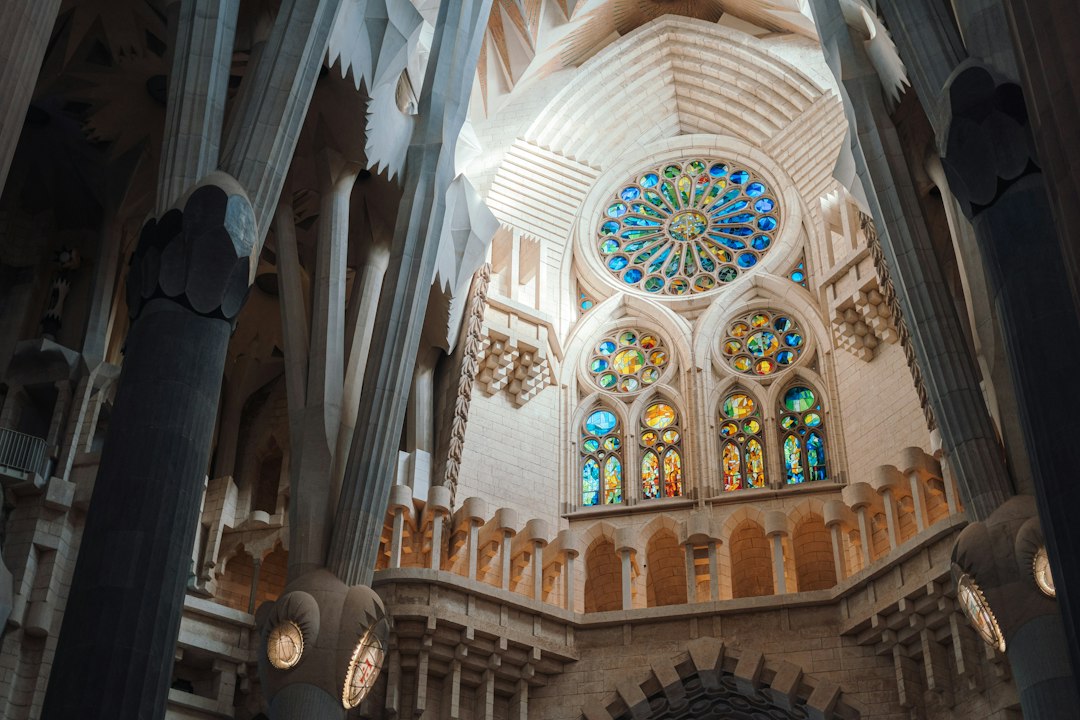
One of the most distinctive features is the system of columns that branch as they rise. The visual effect resembles tree trunks dividing into branches, but the form is also structural: it helps transfer the weight of the vaults downward.
The changing heights, shapes and materials of the columns correspond to different structural loads. Light enters through large stained-glass windows and changes dramatically through the day, so the interior is not experienced as a uniformly lit stone hall.
The Nativity façade
The Nativity façade is particularly important because it was developed substantially during Gaudí’s lifetime. Work began in 1891, and the Saint Barnabas bell tower was completed in 1925.
Its dense sculpture and natural motifs express themes connected with Christ’s birth and life. Plants, animals and human figures fill the façade, making it visually very different from the austere Passion side.
The Passion façade
The Passion façade deliberately uses a harsher architectural language. Its subject is Christ’s suffering and death, and its sculptural program is dominated by the angular work of Josep Maria Subirachs.
The contrast with the Nativity façade is intentional: one side is abundant and life-filled, while the other is stripped back and severe.
The Glory façade
The Glory façade is the main remaining large façade and is still part of the unfinished work. Official construction material published by the Sagrada Família lists its completion date as still to be determined.
That distinction matters in 2026. The completion of the six central towers does not mean the entire basilica is finished.
The towers and what changed in 2026
Gaudí’s overall tower composition assigns different heights and roles to the apostles, evangelists, the Virgin Mary and Jesus Christ. The central Tower of Jesus Christ is the highest.
According to the official chronology, the exterior of the Tower of Jesus Christ was completed on 20 February 2026 with the placement of the upper arm of the cross. On 10 June 2026, Pope Leo XIV presided over a Mass marking the centenary of Gaudí’s death and blessed the tower.
The basilica’s own construction booklet now lists all six central towers as finished in 2026, while the Glory façade and completion of the basilica remain in a later construction phase.
Gaudí did not expect to finish it himself
The long construction period is not simply the result of a project that “ran late”. Gaudí understood the scale was beyond one lifetime and developed models and a general architectural system that later generations could continue.
The project suffered a severe interruption in 1936 when workshop material, plans and plaster models were damaged during the Spanish Civil War. Later architects reconstructed and interpreted surviving material to continue the work.
Why geometry matters
The basilica is notable for the use of geometries that can look organic despite being mathematically rigorous. Hyperboloids, paraboloids and other ruled surfaces help create openings, vaults and transitions that would be difficult to achieve with conventional flat or purely cylindrical forms.
This combination of structural calculation and natural appearance is one reason the building feels simultaneously engineered and organic.
How to look at the building when you visit
- Walk around the exterior first. Compare the Nativity and Passion façades before entering.
- Look upward inside. Follow a column from its base through its branching structure into the vault.
- Notice the light. The stained glass changes the atmosphere depending on orientation and time of day.
- Separate old and new work. The basilica is a multi-generation project, not a building made at one moment.
- Use the museum/exhibition material. Models and explanations make the geometry much easier to understand.
Is the Sagrada Família finished?
No. In 2026, the six central towers are complete, including the exterior of the Tower of Jesus Christ, but official Sagrada Família material still lists the Glory façade and completion of the basilica as work whose final date is to be determined.
For detailed official material on the architecture, symbolism and construction phases, the foundation publishes a series of Sagrada Família information booklets.
Planning the actual visit
This article intentionally does not duplicate ticket prices, opening hours or tower access rules because those details can change. For that information, see our current Sagrada Família Tickets, Towers & Best Time to Visit guide and our broader Barcelona Travel Guide.
Last reviewed: September 2026.